
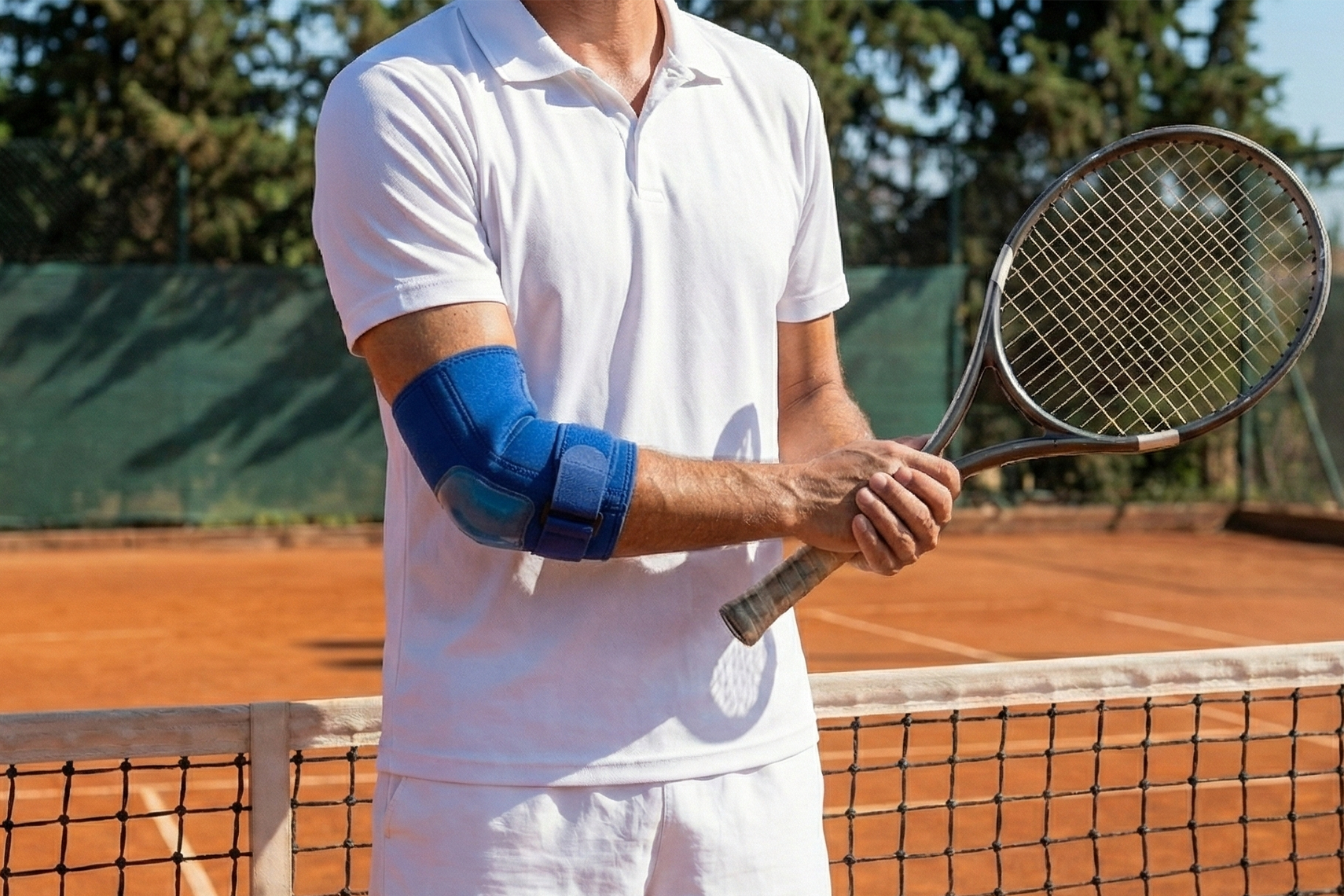
Elbow pain is an extremely common symptom throughout the year. At our clinic, we see many patients who enjoy golf or tennis, as well as those who injure their elbows during weight training—partly due to our partnership with Gold’s Gym.
It is not uncommon to see cases where:
- Sudden pain strikes the outer elbow and does not improve even after a few days of rest.
- Months have passed since the onset, eventually making it impossible to exercise.
In many of these cases, the condition is what is commonly known as Tennis Elbow (Lateral Epicondylitis). Despite the name, the vast majority of cases occur regardless of whether the person plays tennis; it can be easily triggered by daily activities such as desk work, housework, carrying heavy objects, or hobbies like golf and weight training.
The Cause of Tennis Elbow
The essence of most tennis elbow cases is a partial tear of the tendon located on the outside of the elbow. Tendons are strong, rope-like tissues that connect muscle to bone, functioning to transmit muscular force to the skeletal system. When microscopic tears occur in this tendon, it leads to persistent, chronic pain.
Why Is It Difficult to Treat? The Role of Finger Movement
A crucial point to understand is that the muscles on the outside of the elbow originate there but are deeply involved in moving your fingers. This means that as long as you use your hands and fingers, your elbow can never truly be at rest. This is the primary reason why tennis elbow is so difficult to heal. In modern life, it is practically impossible to live without using our hands.
Furthermore, tendons are known to have a low natural healing capacity. The window of time in which the body can effectively repair itself is limited. If pain persists for several months, the partial tear may remain indefinitely regardless of rest, leading to long-term discomfort. Consequently, oral painkillers and patches often have limited effectiveness, and even steroid injections frequently fail to provide a lasting cure.
PRP Therapy: A Powerful Alternative
For such cases, PRP (Platelet-Rich Plasma) therapy is a highly effective treatment option. PRP involves taking a high concentration of platelets—which contain growth factors—from your own blood and injecting them into the affected area. This is expected to reinforce the collagen fibers of the damaged tendon and stimulate tissue repair.
What is PRP Therapy (Platelet-Rich Plasma)? This treatment promotes tissue repair by injecting highly concentrated platelets, extracted from the patient’s own blood, into the affected area. Because it utilizes your own blood, the risks are minimal, and it is less taxing on the body compared to surgery. It is a viable option for a wide range of conditions, including osteoarthritis and sports-related joint issues.
[Learn More] https://nagseikei.jp/stiffshoulders/237/
Treatment Progress
Improvement typically begins as early as two weeks, with most patients noticing changes around the four-week mark. Unlike conventional painkillers, the onset of the effect is gradual; however, once improvement begins, the results tend to be long-lasting. By promoting the repair of damaged tissue rather than just masking the pain, we aim for a state where recurrence is less likely.
At our clinic, if an evaluation deems you a suitable candidate, it is possible to perform the PRP preparation and injection on the same day as your consultation. We provide this option so that those whose daily lives or sports activities are hindered by pain can begin their recovery immediately.
Typically, patients who undergo PRP treatment for tennis elbow can expect a phased return to sports like golf, tennis, or training within one to two months. Note: Individual results and progress may vary.
Important Information Regarding Private Practice (Non-Insured Treatment)
PRP therapy is not covered by public health insurance (Private Practice).
- Cost (incl. tax): PRP Injection: 132,000 JPY (Initial and follow-up consultation fees are separate.)
Please note that treatment prices are subject to periodic review. For the latest information, please refer to our pricing page. - Main Risks/Side Effects: Potential for pain at the injection site, swelling, heat sensation, bruising, infection, or rare allergic reactions. Pain may temporarily increase for a few days following the injection as part of the body’s natural inflammatory repair process.
A Message from the Doctor
In my daily practice, I have witnessed firsthand the profound utility of PRP therapy for tennis elbow. If you have been suffering from long-term outer elbow pain or have been getting by with just patches and painkillers, please come in for a consultation. Rather than struggling with the pain indefinitely, an accurate evaluation and the right treatment choice will lead to a significantly faster recovery.
Director of NAG Orthopedics: Yoshimasa Nagumo
Orthopedic Specialist & Sports Doctor
Dr. Nagumo initially built his career as a surgical oncologist specializing in orthopedic cancer treatment. Subsequently, he moved to the United States to engage in advanced research in the field of regenerative medicine.
It was during his time in the U.S. that a personal injury led him to realize the critical importance of sports medicine. Upon returning to Japan, he transitioned his focus to become a sports orthopedic surgeon.
Currently, he leads the "Athlete Support Program," which provides comprehensive medical support to athletes using a combination of blood analysis and cutting-edge regenerative medicine technologies.
[Click here for the program introduction page:https://nagseikei.jp/en/dr/]

