
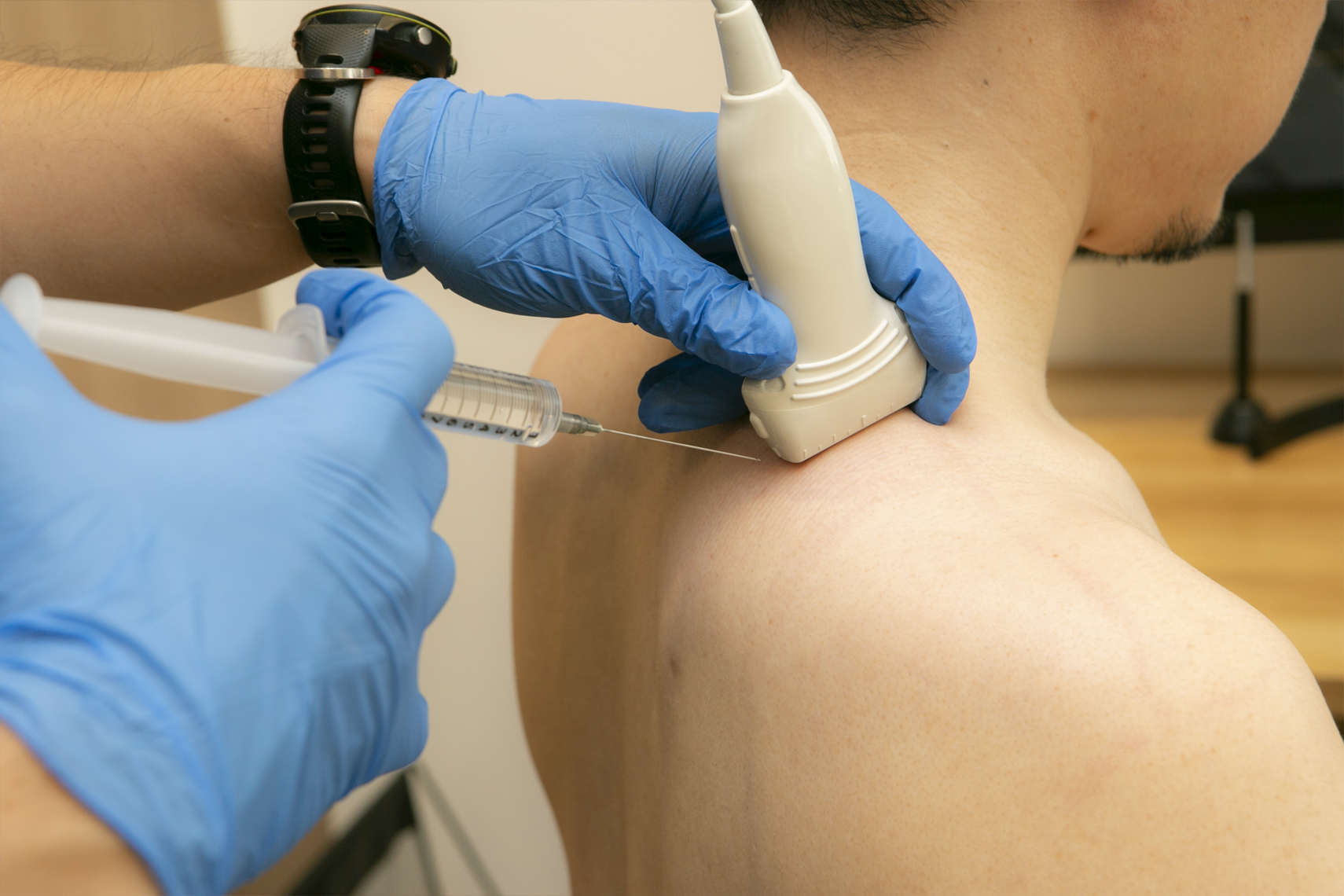
What is PRP? Its Mechanism and Fundamental Function
PRP (Platelet-Rich Plasma) therapy is a treatment method where components called platelets are extracted from the patient's own blood, highly concentrated, and then returned to the affected area.
Platelets are known as the "building blocks of scabs." When injured, they play a crucial role in suppressing inflammation and repairing damaged tissue. Inside platelets, there are abundant "growth factors" that promote tissue repair. By concentrating and administering these factors, this therapy is expected to elicit the body's inherent natural healing power for damage to muscles, tendons, ligaments, cartilage, and chronic inflammation.
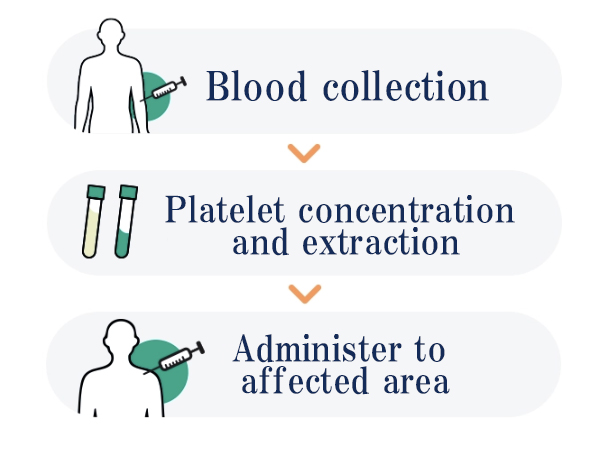
The Three Important Roles of Platelets
- Hemostasis: Stops bleeding.
- Promotion of Tissue Repair: Releases growth factors and stimulates cell proliferation.
- Suppression of Inflammatory Response: calms the inflammation that is the source of pain.
For pain in joints, muscles, and tendons, the processes of ② and ③ are particularly critical points.
Features of PRP Therapy: Why We Focus on Regenerative Medicine
A major advantage of PRP therapy is its utilization of the patient's own blood components, resulting in an extremely low risk of allergic or rejection reactions. Based on our clinical experience at this clinic to date, no serious side effects have been observed, confirming its high safety profile.
Steroid injections, commonly used in orthopedics, possess strong anti-inflammatory effects but can also potentially cause tissue weakening, leading to limitations on the number of administrations. Conversely, PRP possesses properties that support tissue repair, and numerous papers have reported its utility. The ability to pursue sustainable recovery while minimizing the risk of side effects is a significant appeal of PRP therapy.
A Specialist's Treatment Philosophy and Approach to PRP Therapy
At our clinic, we don't just treat symptoms; we prioritize providing care that resonates with the "thoughts" underlying each patient's circumstances. Rooted in this approach are the memories of various injuries I have personally experienced throughout my long history of sports and training.
There were times in the past when pain persisted even after receiving standard treatments, and I felt the frustration of not being able to move as I wished. Beyond the pain itself, the impatience of being immobile and the anxiety about the future pose significant mental burdens for patients.
Based on that experience and medical knowledge, I have deeply validated the mechanisms of various treatment methods and verified their processes. Within that exploration, I focused on the potential of PRP therapy (Platelet-Rich Plasma therapy) as a regenerative medicine that supports the body's natural healing power.
For conditions where "sufficient change was not seen with conventional conservative therapy alone," PRP treatment can serve as a new option. Drawing upon numerous clinical studies from Japan and abroad, as well as the progress observed at our clinic, we actively propose this treatment to eligible patients as a useful means of aiming for functional recovery of tissue.
Reasons for Choosing PRP Therapy
Depending on the condition, repetitive administration of PRP therapy is possible. Many cases are seen where functional improvement and pain reduction can be expected in stages by repeating the treatment.
Rather than a "single injection and done" approach, the essence of this treatment is the perspective of "supporting the body's repair at the optimal timing according to the degree of pain or damage." This option can serve as a new beacon of hope for those who did not achieve desired results with conventional treatments.
す。
Representative Examples of Conditions for Which PRP is Suitable
At our clinic, we widely perform PRP treatment for joint diseases and disorders of muscles and tendons, among others.
Indications are not limited solely to the disease names and pathological conditions listed below, and we can address various musculoskeletal disorders that are difficult to treat.
① Joints
Osteoarthritis (knee, shoulder, hip, etc.)
Joint cartilage damage, meniscus tear of the knee
Arthritis (inflammatory pain of any cause), etc.
② Muscles and Tendons
Rotator cuff tear of the shoulder
Achilles tendonitis
Lateral epicondylitis (tennis elbow), medial epicondylitis (golfer's elbow)
Tenosynovitis
Muscle damage, myofasciitis
Ligament injury (including after sprains), etc.
Position of PRP Treatment and Our Clinic's Treatment Policy
PRP treatment was introduced in the late 1990s and has gained widespread application not only in orthopedics but also in various other fields. In addition to expecting higher therapeutic effects compared to conventional treatments, its key characteristics include enabling an approach close to fundamental treatment by promoting tissue repair and its minimally invasive nature, as it is completed through injection alone.
It is a treatment that clearly differs from symptomatic therapy and is distinct from seemingly endless long-term rehabilitation.Positioned between conservative therapy and surgical therapy, it has now become one of the essential treatments in orthopedic practice.
PRP therapy is a self-pay treatment that is not covered by health insurance.
Cost (Self-Pay)
PRP Therapy (per area): 132,000 yen (tax included)
First Examination Fee (Self-Pay): 6,600 yen (tax included)
Please note that treatment prices are subject to periodic review. For the latest information, please refer to our pricing page.
Side Effects and Risks
Temporary pain, swelling, heat sensation, internal bleeding may occur, and there is a rare risk of bacterial infection. Results vary by individual, and this does not guarantee similar results for all cases.
Number of Treatments and Duration
Number of Treatments: Typically one session (multiple sessions may be considered depending on symptoms).
Treatment Duration: Including follow-up observation, it requires approximately 3 to 6 months.
Please consult with us at least once if you are suffering from chronic pain or recurrent inflammation.
Director of NAG Orthopedics: Yoshimasa Nagumo
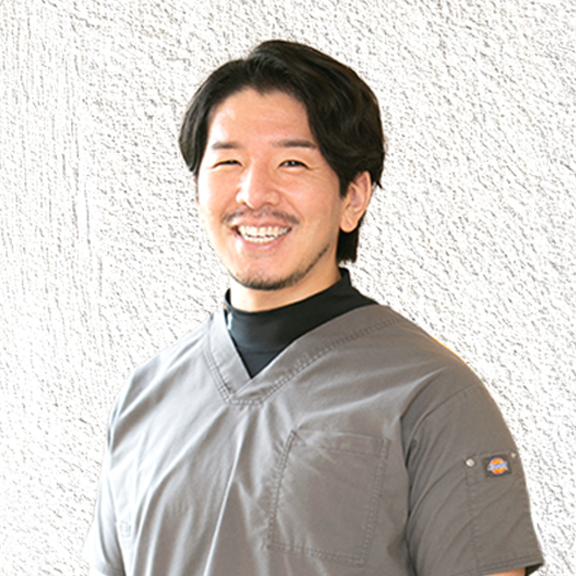
Orthopedic Specialist & Sports Doctor
Dr. Nagumo initially built his career as a surgical oncologist specializing in orthopedic cancer treatment. Subsequently, he moved to the United States to engage in advanced research in the field of regenerative medicine.
It was during his time in the U.S. that a personal injury led him to realize the critical importance of sports medicine. Upon returning to Japan, he transitioned his focus to become a sports orthopedic surgeon.
Currently, he leads the "Athlete Support Program," which provides comprehensive medical support to athletes using a combination of blood analysis and cutting-edge regenerative medicine technologies.
[Click here for the program introduction page:https://nagseikei.jp/en/dr/]

