

What Are Stem Cells?
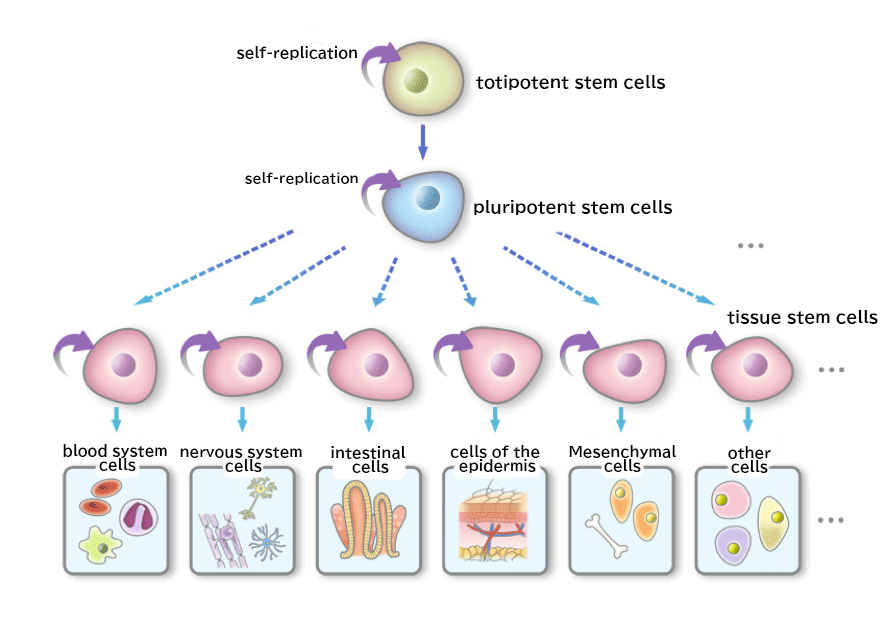
▲ What are stem cells? (Source: SKIP)
Stem cells refer to a group of undifferentiated cells present within the human body that have the ability to differentiate into various types of specialized cells.
Stem cells can be classified into several developmental stages. ES cells (embryonic stem cells) and iPS cells (induced pluripotent stem cells) are known as totipotent or pluripotent stem cells, which possess the ability to differentiate into cells of any tissue types.
On the other hand, the stem cells widely utilized in our clinical practice are multipotent cells called somatic stem cells. These somatic stem cells exist in two types: those circulating throughout the body via the bloodstream, and those residing permanently within specific tissues.
Stem cells are characterized by their ability to differentiate into specific cells while replicating themselves. The ability to replicate oneself is called "self-renewal capacity," and the ability to differentiate into specific types of cells is called "differentiation potential." These are crucial functions that define stem cells. In addition to these capabilities, stem cells are defined by the presence of specific characteristic molecules (known as cell markers).
In any tissue damaged by inflammation or other causes, stem cells differentiate into the same type of cells as that tissue, contributing to tissue regeneration and wound healing.
Stem Cells Are Broadly Categorized into Three Types
Totipotent Stem Cells
Cells that have the ability to develop into an entire individual organism from a single cell, which refers to a fertilized egg.
Pluripotent Stem Cells
体内のあらゆる細胞に分化することができる細胞です。
Cells capable of differentiating into any cell type within the body. This category includes ES cells (embryonic stem cells) created from early-stage fertilized eggs, and iPS cells (induced pluripotent stem cells), which are generated from somatic cells by introducing the Yamanaka factors discovered by Dr. Shinya Yamanaka of Kyoto University.
Multipotent Cells (Somatic Stem Cells)
Cells that continuously generate new cells within specific tissues, such as internal organs or skin, to replace damaged cells. They have the ability to form cells identical to the tissue they reside in. For instance, hematopoietic stem cells differentiate into blood cells, while neural stem cells differentiate into nervous system cells. However, recent research has revealed that they can also differentiate beyond the boundaries of their original tissue type.
Growth Factors Secreted by Stem Cells
Stem cells harvested from tissue are cultured inside containers called culture dishes. Over time, the stem cells inside the dish continuously divide and increase in number.
During this process of division and proliferation, stem cells secrete substances called growth factors (cytokines), helping each other grow and multiply through these secreted factors. This can be easily understood by imagining a mutual aid society or association, where members pool small amounts of money to support one another in times of need. In other words, the culture medium used to grow stem cells contains a rich abundance of growth factors secreted by the cells. When administered into our bodies, these growth factors are carried to damaged tissues, where they suppress local inflammation, help relieve pain, and reduce fatigue.
What is Stem Cell Conditioned Medium?
Stem cell conditioned medium (also referred to as stem cell culture supernatant fluid) is the liquid obtained by removing all cellular components from the medium in which stem cells were cultured. Simply put, it is the supernatant liquid left over from the cultivation process.
There are two types of stem cell conditioned mediums:
①Autologous (Using Your Own Cells)
This is the conditioned medium obtained during the culturing process of your own stem cells. Because it utilizes your own cells and tissues, it is referred to as "autologous," and this treatment is sometimes specifically highlighted as "Autologous Stem Cell Conditioned Medium Therapy."
②Allogeneic (Using a Third-Party's Cells)
If a culture medium containing someone else's stem cells were administered directly, it would amount to transplanting another person's cells, which poses risks such as immune reactions. However, since the conditioned medium contains no cellular components, it can be safely administered even if it is derived from another person's stem cells. To distinguish this from the autologous type, it is called "Allogeneic Stem Cell Conditioned Medium."
Mechanism of Stem Cell Conditioned Medium Therapy
This treatment involves introducing a culture medium rich in growth factors into the body to trigger various biological responses. The administration route varies depending on the targeted condition or disease.
- Treatment for Chronic Fatigue (Intravenous Drip)
When inflammation or tissue damage occurs in our bodies, this information is transmitted to the brain via immune cells and is perceived as a sensation of fatigue. Furthermore, repairing damaged cells requires energy. If adequate energy production is not carried out—contrary to the brain's signals—the transmission of signals from the damaged cells continues chronically, leading to fatigue symptoms such as pain and malaise.
When stem cell conditioned medium is administered via intravenous (IV) drip, the growth factors and cytokines it contains circulate throughout the entire body. By conditioning the tissue environment, this approach is expected to reduce fatigue and support overall health management.
- Approach for Scalp Care and Hair Concerns (Scalp Injection)
For concerns regarding disrupted hair cycles or loss of hair volume, injections are performed to improve the condition of the scalp environment and hair follicles. Growth factors keep the scalp healthy and support the creation of a wholesome environment for hair. This is believed to be associated with effects that maintain a healthy scalp environment and promote blood circulation.
What is an Exosome?
Exosomes are granular substances secreted by cells that are used for intercellular communication. The interior of these granules contains genetic information and environment-dependent proteins from the cells. By exchanging these, cells share information about the environment they exist in.
To put it simply, exosomes refer to cellular secretions, which are entirely distinct from growth factors (cytokines). On the other hand, inside a conditioned medium, both the growth factors secreted by stem cells and exosomes are present in a mixed state. Because this liquid containing various mixed substances is called "stem cell conditioned medium," referring to it simply as "exosomes" is technically inaccurate. However, because the katakana term "Exosome" sounds more appealing to the general public than the kanji-heavy "Stem Cell Conditioned Medium," the name "exosome" has become much more widely known. Therefore, at our clinic, we list them side-by-side as "Exosome (Stem Cell Conditioned Medium) Therapy."
In recent years, "Exosome Therapy," where only exosomes are extracted from the conditioned medium and administered, has gradually commenced. At this stage, we do not have definitive data comparing pure exosome therapy with stem cell conditioned medium therapy, so we cannot comment on its clinical significance. As research progresses, it may be revealed in the future that extracted exosomes alone deliver superior health benefits.
Flow of Stem Cell Conditioned Medium Therapy
Regardless of the administration route, treatment can be performed on the day of your visit.
- For Intravenous (IV) Drip: Administration time is approximately 30 minutes.
- For Hair Growth Injections: Treatment time is approximately 5 to 10 minutes.
Exempt from Anti-Doping Regulations
This treatment is exempt from anti-doping regulations regardless of the site of administration. Therefore, individuals engaged in sports or athletic activities can receive the treatment at any time without worrying about timing.
Regarding insurance coverage for stem cell culture supernatant
Currently, stem cell conditioned medium therapy is not covered by health insurance, regardless of the administration route (IV drip or scalp injection).
Fees and Risks for Private Practice (Self-Pay / Not Covered by Insurance)
This treatment is a voluntary, self-pay medical service that is not covered by Japanese public health insurance.
Fees
・IV Drip: ¥86,000 (inc. tax) per session / ¥206,400 (inc. tax) for 3 sessions
・Scalp Injection: From ¥55,800 (inc. tax) per session
Estimated Number of Treatments and Period:
・Chronic Fatigue (IV Drip): Performed at an appropriate frequency based on your physical condition and goals, in consultation with a physician.
・Hair Growth Treatment (Scalp Injection): We recommend a frequency of once a month for approximately 3 months (3 sessions in total).
Main Risks and Side Effects
・Pain, redness, swelling, internal bleeding (bruising) at the injection site, temporary fever, or allergic reactions may occur. In addition, because an allogeneic (third-party derived) conditioned medium is used, the risk of unknown infectious diseases cannot be completely ruled out.
・Individuals currently undergoing cancer treatment, those with active infections or a fever, those with drug hypersensitivity, or those taking immunosuppressants may not be eligible for treatment based on the physician's assessment
・Please note that although a fatal accident involving a patient receiving a stem cell conditioned medium IV drip occurred in Japan in October 2023, no clear causal relationship with the conditioned medium itself has been established at this stage. At our clinic, we prioritize safety above all else and perform administrations under strict guidelines.
【Information Regarding Unapproved Drugs, etc.】
・Approval Status: The allogeneic stem cell conditioned medium used in this treatment constitutes an unapproved drug under the Act on Securing Quality, Efficacy and Safety of Products Including Pharmaceuticals and Medical Devices (Pharmaceuticals and Medical Devices Act / PMD Act).
・Obtainments / Procurement Route: Our clinic procures this liquid for therapeutic use through an appropriate process from a reliable domestic cell culture facility (partner institution).
・Existence of Identical Approved Drugs in Japan: There are no approved drugs in Japan that contain identical components or offer the same efficacy.
・Approval Information in Foreign Countries: There are no major countries where products with identical components or efficacy have obtained official regulatory approval.
For those who wish to receive Stem Cell Conditioned Medium Therapy (Self-Pay) at NAG Orthopedics
please make a reservation via the link below.
Director of NAG Orthopedics: Yoshimasa Nagumo
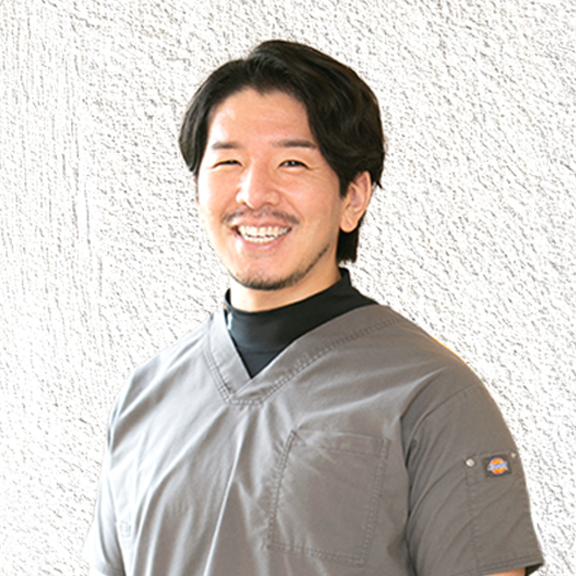
Orthopedic Specialist & Sports Doctor
Dr. Nagumo initially built his career as a surgical oncologist specializing in orthopedic cancer treatment. Subsequently, he moved to the United States to engage in advanced research in the field of regenerative medicine.
It was during his time in the U.S. that a personal injury led him to realize the critical importance of sports medicine. Upon returning to Japan, he transitioned his focus to become a sports orthopedic surgeon.
Currently, he leads the "Athlete Support Program," which provides comprehensive medical support to athletes using a combination of blood analysis and cutting-edge regenerative medicine technologies.
[Click here for the program introduction page:https://nagseikei.jp/en/dr/]

